
October 2026 Digital Marketing Updates: Top 10 Stories
October 2026 put numbers behind the evolving AI search landscape. Google AI Overviews now appear on most branded searches, and Google is updating the format of AI answers. New research shows that ranking in Google’s top 10 still predicts AI recommendations across ChatGPT, Gemini and other engines. Another study found that being mentioned in an AI answer and being cited as a source are separate outcomes, and Google shared its own timelines for how long SEO changes take to show up.
Measurement and trust got a harder look. An analysis found that hidden AI traffic is mostly bots, only 41% of marketers can prove their AI return on investment, and shoppers distrust AI used on them but values AI that works for them. The platforms kept moving too. Meta’s Muse reached small businesses, and Google and TikTok both launched ways to buy or capture leads without leaving their apps.
Here are the digital marketing updates that matter most from October 2026 and what they mean for your business. Find last month’s updates here. At EisnerAmper, we help businesses translate shifts like these into practical growth and marketing strategies. We stay on top of the latest updates, so you can focus on growing your business. Get in touch to learn more.
1. Google AI Overviews Now Appear on Most Branded Searches
AI Overviews have moved onto the searches people run when they already know your name. Semrush reported that DemandSphere data showed AI Overviews on 26% of tracked branded queries on September 1, but that share peaked above 90% on September 27 and stood at 82% on September 29. Ahrefs, which looked only at U.S. desktop results, started higher at 65% in August and also finished September above 80%. Search consultant Chris Long found AI Overviews for 93 of 100 enterprise brands he tested. Google has not announced a change or explained the jump.
The data shows that AI Overviews appear on branded searches. It does not show whether brands are named or cited inside them, so what Google says about your business is worth checking directly.
What this means for your business: Search your business name while signed out and read the AI Overview the way a customer would. Check the facts, the pages it cites, and whether a competitor appears alongside you. Then compare your branded click-through rate in Google Search Console from early September to October. Steady rankings with a falling click-through rate could point to the AI Overview as the cause.
2. Google Updates Source Links in AI Answers
Google says it is changing how AI Mode and AI Overviews send people to websites. First, it is adding more inline links, the clickable words and phrases inside an AI response. Google says it has made “continued and substantial increases” to how often they appear, and it is launching updates that show them higher up in responses more frequently.
Second, it will test a dedicated section at the top of AI responses for cases where only one or two official pages exist for a task. The section will surface those links with context on why each is useful, building on how Google already shows links front and center when someone is looking for a particular site. Third, the links at the end of some AI responses will get image thumbnails and a more clickable design, so related articles are easier to spot and open.
Google shared no click data, so the size of any traffic gain is unknown. The post gives no dates for the link changes.
What this means for your business: Links in AI answers are getting more visible, which makes being a cited source worth more. Make sure your service, location, pricing and contact pages are current, because those are the pages most likely to fill an official-page slot. Record your current referral traffic from AI surfaces in GA4 now so you can judge the effect when these changes reach your queries.
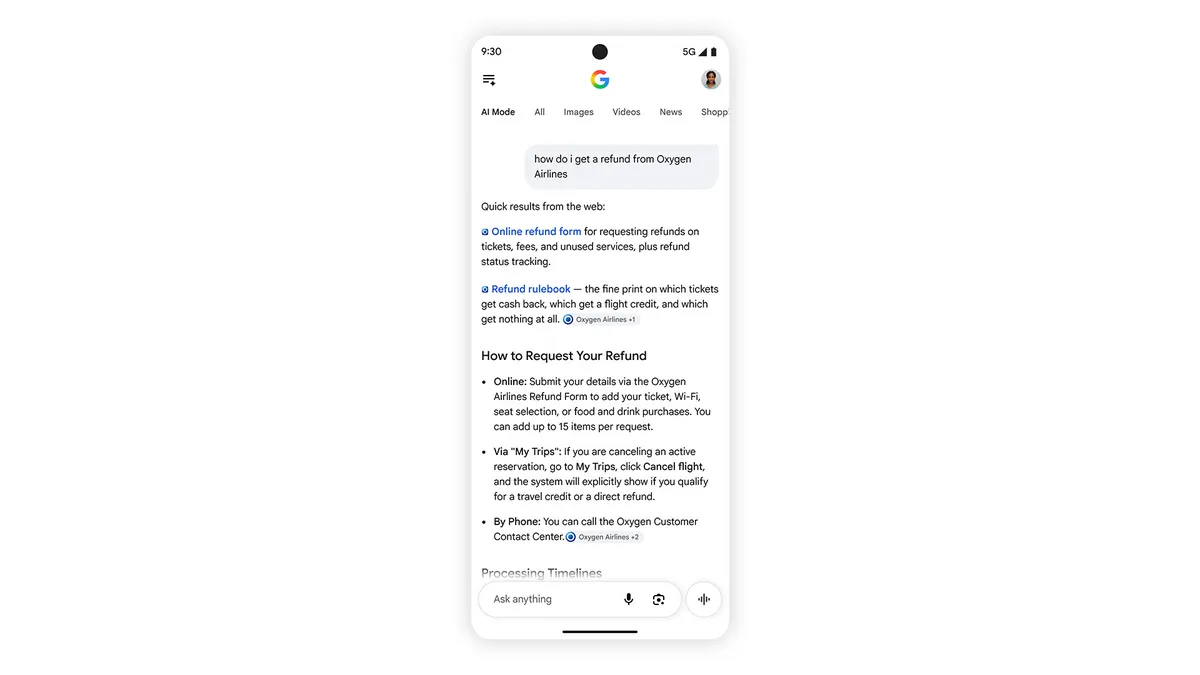
3. Ranking in Google’s Top 10 Still Predicts AI Recommendations
A Minuttia and Convex Works study analyzed 24,067 prompts across Google (with AI Overviews), ChatGPT, Gemini, Claude, and Perplexity. Software brands ranking on Google’s first page were 6.8 to 11.6 times more likely to be named by an AI engine than brands outside it, depending on the engine and the type of prompt. Brands in the top quartile for review volume appeared in AI Overviews 5.9 to 7.6 times as often as those in the bottom quartile. Star ratings showed no meaningful link.
The engines also disagree with each other. Only 8% to 9% of recommended brands appeared in all five engines’ answers to the same prompt, so one engine’s results say little about the rest.
What this means for your business: SEO and AEO work toward the same goal, and strong organic rankings plus a steady flow of customer reviews tend to come before AI visibility. Emphasize both, and check how you appear on more than one AI platform.
4. A Mention and a Citation Are Different Wins
Semrush’s 2026 AI Visibility Index, covered by MarTech, tracked 22 categories across four AI platforms. In every month measured, fewer than half of the top 100 mentioned brands also ranked among the top 100 cited sources. For example, Ford appeared in all four platforms’ top-100 mention lists, yet its own website ranked between 748th and 1,320th for citations. Chevrolet, Disney, Honda, Nintendo, and Toyota showed the same gap.
Platforms behave differently as well. Gemini named more distinct brands per answer than ChatGPT, while ChatGPT listed the most sources. Category mattered more than platform. Real estate had the same four source sites recurring on every platform, and industrial had no stable core.
What this means for your business: A single AI visibility score can hide where the problem sits. If AI names you but cites other sites, the fix may sit with reviews, directories, press coverage, or partner pages that your own site cannot solve. Start with a fixed list of the questions your customers ask. Record separately whether you are mentioned and whether your site is cited, then give each gap to whoever can fix it.
5. Hidden AI Traffic Is Mostly Bots
Kevin Indig analyzed Google Analytics 4 data from 12 sites to find AI visits hiding in “Direct” traffic. From January to September, total Direct sessions rose 141% while engaged Direct sessions were flat. One site logged 409,000 Direct sessions, and only 198 were engaged. Sessions with identifiable AI traces made up 0.003% of Direct traffic on average. Across 632 tests on four brands, he also could not establish a reliable link between AI visibility and later branded search or Direct visits. The sample is small and skews toward B2B.
One team did find a signal. Ramp attributed 30% to 40% of its Direct traffic to answer engines by filtering for long blog URLs and confirming the source through self-reported attribution.
What this means for your business: Do not read a Direct traffic spike as an AI win. Filter for engaged sessions first. Then ask customers how they found you, using a form field and a question on sales calls, and record the AI tool they name. Review marketing data monthly to find: where your brand appears in AI answers, how customers say they found you, and what those leads are worth.
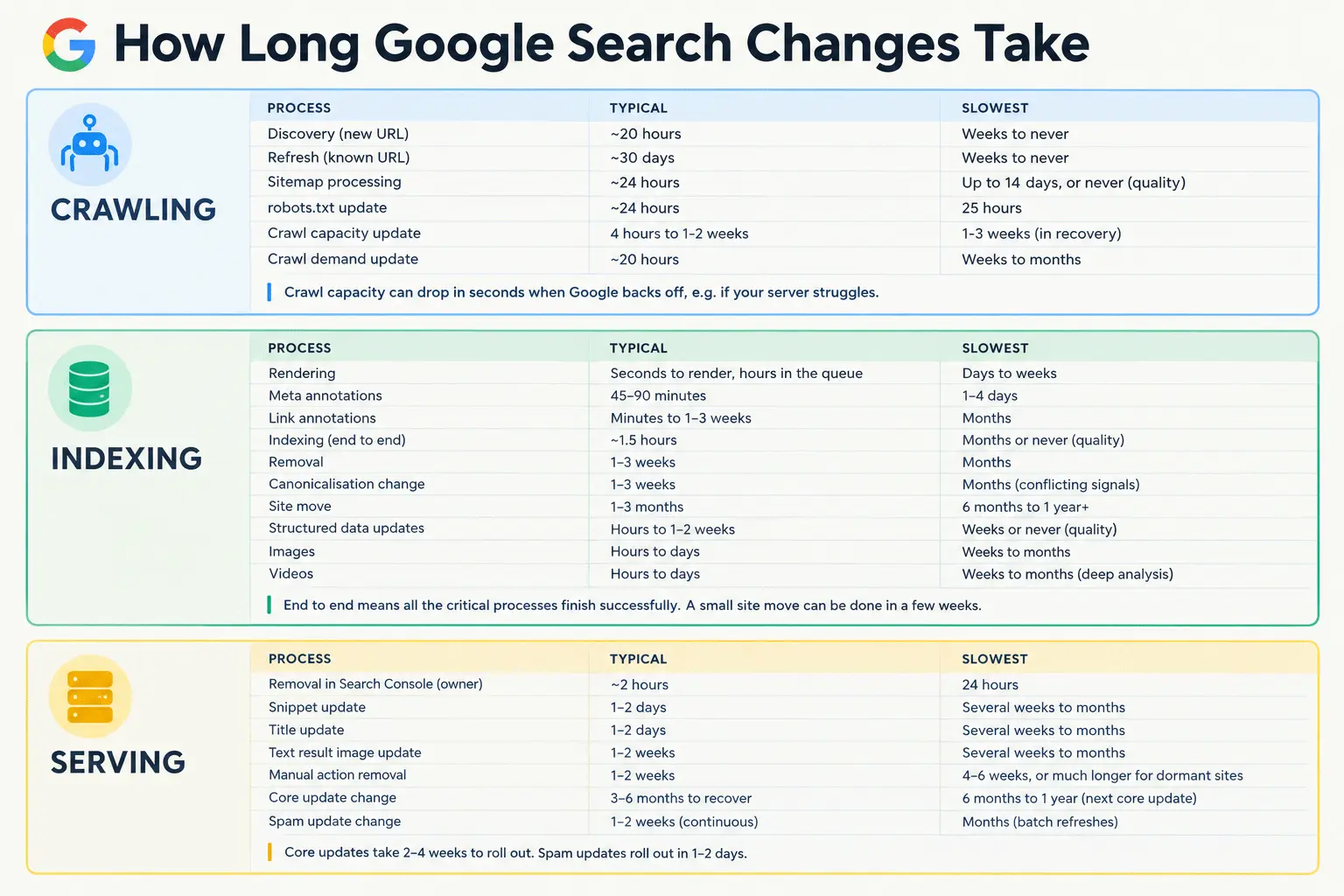
6. Google Shares How Long SEO Changes Take
At a Google Search Central Live event in Barcelona, Google’s Gary Illyes presented internal data on crawling, indexing, and serving, reported by Search Engine Roundtable. Typical times were about 20 hours to discover a new URL, about 1.5 hours to index a page end to end, 1 to 2 days to update a title or snippet, and 1 to 3 months for a site move. Recovery from a core update typically takes 3 to 6 months and can stretch to a year if it waits for the next update.
The slow end is slower. Some new pages take weeks to be discovered or are never found, and indexing can take months or never happen when quality is the issue. Illyes noted that the steps are linked, so delays stack up, and called the figures an internal exercise to test whether the audience could relate to them.
What this means for your business: SEO pays off on a calendar of weeks and months. Judge title and snippet changes in days, content and technical fixes in weeks, and a core update recovery over two quarters. With the holidays close, fix titles, sitemaps, and indexing problems now.
7. 96% of Marketers Use AI, but Only 41% Can Prove It Pays
Alexander Group’s 2026 research covers more than 300 companies across 11 industries. It found that 96% of marketers use AI, 41% can prove return on investment, and 31% have governance in place. Customer acquisition costs are up at least 60% since 2022, and buyers complete 70% of their evaluation across 10 channels before they engage. Among top performers, 63% apply AI to five or more use cases.
Harvard Business Review adds that AI transformation tends to raise costs and complexity before it lowers them. Authors Michelle Taite and Will Fernandez describe three stages: codify the judgment your best marketers apply, connect those rules into reusable workflows, and compound the returns as information flows across the team.
What this means for your business: Pick two or three uses of AI and set the metric before you start, such as hours saved, cost per lead, or response time. Review results at 90 days. Write down what AI may draft and who approves it, and expect efficiency to dip while your team learns.
8. Shoppers Distrust AI Used on Them and Welcome AI That Helps Them Shop
A Talker Research survey of 2,000 U.S. adults, commissioned by Auros, found that 43% have felt duped by an AI ad. Thirty-six percent believe a product is lower quality when AI is used in its marketing, against 17% who believe it is higher quality. People also struggle to tell the difference, and only 20% correctly identified real products that had been enhanced with AI. At the same time, 53% say AI has helped them shop and 54% plan to use it for holiday shopping.
A study covered by Inc. adds a people angle. Eight studies with 2,317 participants, published in the Journal of Personality and Social Psychology, found that people who consulted AI instead of a human expert were judged as less warm and emotionally capable. The penalty shrank among people with favorable views of AI.
What this means for your business: Use AI behind the scenes for research, drafts, and speed, but put real photos, real people, and real reviews up front. Keep a human voice on messages where customers expect someone to care, such as apologies, thank-you notes, and complaint replies.
9. Meta’s Muse Becomes a Small Business Assistant
Meta recently launched Muse for Small Business, adding connectors to tools such as QuickBooks, Shopify, Stripe, Canva, Klaviyo, Slack, and Asana, along with Facebook and Instagram business accounts. You give Muse a goal, such as finding new customers or reviewing the month’s finances, and it works across those tools. Meta says nothing publishes, sends, or spends without your approval. It is free for most uses, with paid tiers, and available in the U.S. and Canada. A day earlier, Meta announced a separate Enterprise Platform to sell its AI tools to larger businesses.
Adoption is fast. Sensor Tower data reported by Yahoo Finance shows 10.9 million downloads since the launch, 10.2 million of them in the U.S.
What this means for your business: Treat Muse as a pilot. Start with read-only tasks such as a monthly sales summary or an expense check before you connect accounts that publish or spend. Review what each connector can access, and keep the approval step switched on.
10. Google and TikTok Move Closer to Closing the Sale Themselves
Google’s Universal Cart launched in the U.S. on October 15 across Search and the Gemini app. It saves products from multiple retailers in one place and sends price-drop and restock alerts drawn from the 60 billion listings in Google’s Shopping Graph. Shoppers can check out with Google Pay at merchants such as Nike, Sephora, Target, and Walmart, and the merchant stays the seller of record.
TikTok announced three related tools on October 5. Buy Direct offers one-click checkout from the For You feed, and Shopping Assistant is a conversational agent that answers product questions. Agentic Leads is an AI agent that captures and qualifies leads through direct messages and lead forms. TikTok is building them with partners including Shopify, Salesforce, and Stripe.
What this means for your business: More of the path from interest to purchase now happens inside Google and TikTok, so fewer shoppers reach your website first. Keep product feeds, prices, availability, and your Google Business Profile accurate. Service businesses with TikTok customers can run a small Agentic Leads test, as long as someone is ready to follow up quickly.
The Bigger Picture from October 2026
The month’s data points the same way. AI answers now show up on most branded searches, and the engines disagree on who to recommend, but Google says it is putting source links higher and rewarding clear official pages. Rankings still feed AI visibility, and SEO changes still take months, so the fundamentals keep paying off. The gap to close is measurement. Separate real engagement from bot traffic, track mentions and citations, and tie AI use in your own marketing to a result you can show.
The practical takeaway is to keep funding SEO and AEO together, check what AI says about your brand, and test every new AI tool against a defined metric with a review date.
At EisnerAmper, we help you translate these ongoing shifts in search, AI visibility, and paid media into a practical growth strategy. We identify which channels are worth testing, which changes need action now, and where your marketing and sales budget will do the most good. If you want a clear read on where your SEO and AI visibility stand heading into the holidays, get in touch with our team for a free assessment.
Share This Article
Other Topics
